The Fate of the S.S. Hagerstown Victory, a WWII Victory Ship
By Abigail Koontz, WCHS Curator & Programs Manager
Originally appeared in The Herald-Mail, Sunday, April 12, 2026
By January 1945, the United States was deeply embroiled in World War II. Over six thousand
soldiers from Washington County served at home and abroad. Washington County families lost
loved ones who were killed, taken prisoner, or assumed missing in Germany, France, Italy, and
the Pacific. In Hagerstown, Fairchild Aircraft adopted the “Hagerstown System,” subcontracting
over twenty-five businesses to produce military aircraft for the war effort.
This spirit of exuberant mobilization and the immeasurable loss of lives did not go unnoticed. On
December 19, 1944, the Bethlehem-Fairfield Shipyard in Baltimore laid a keel for a Victory ship
named the S.S. (Steam Ship) Hagerstown Victory, in honor of Hagerstown’s contributions to the
war effort.
Since 1939, the U.S. Maritime Commission, and later the War Shipping Administration, oversaw
a large-scale emergency shipbuilding program. Established in 1941, the Bethlehem-Fairfield
Shipyard was owned by Bethlehem Shipbuilding Company and Bethlehem Steel Corporation of
Bethlehem, PA. By 1945, the shipyard employed over 27,000 employees who produced Liberty
ships, Victory ships, and Landing Ship Tanks (LSTs).
Manufactured first, Liberty ships were mass-produced cargo vessels that traveled 11-12 knots
and carried 10,200 tons of cargo such as jeeps, tanks, and ammunition. Victory ships, in
comparison, were sleeker and stronger, capable of carrying 10,700 tons and travelling 15-17
knots with a 6,000 horsepower steam turbine engine.
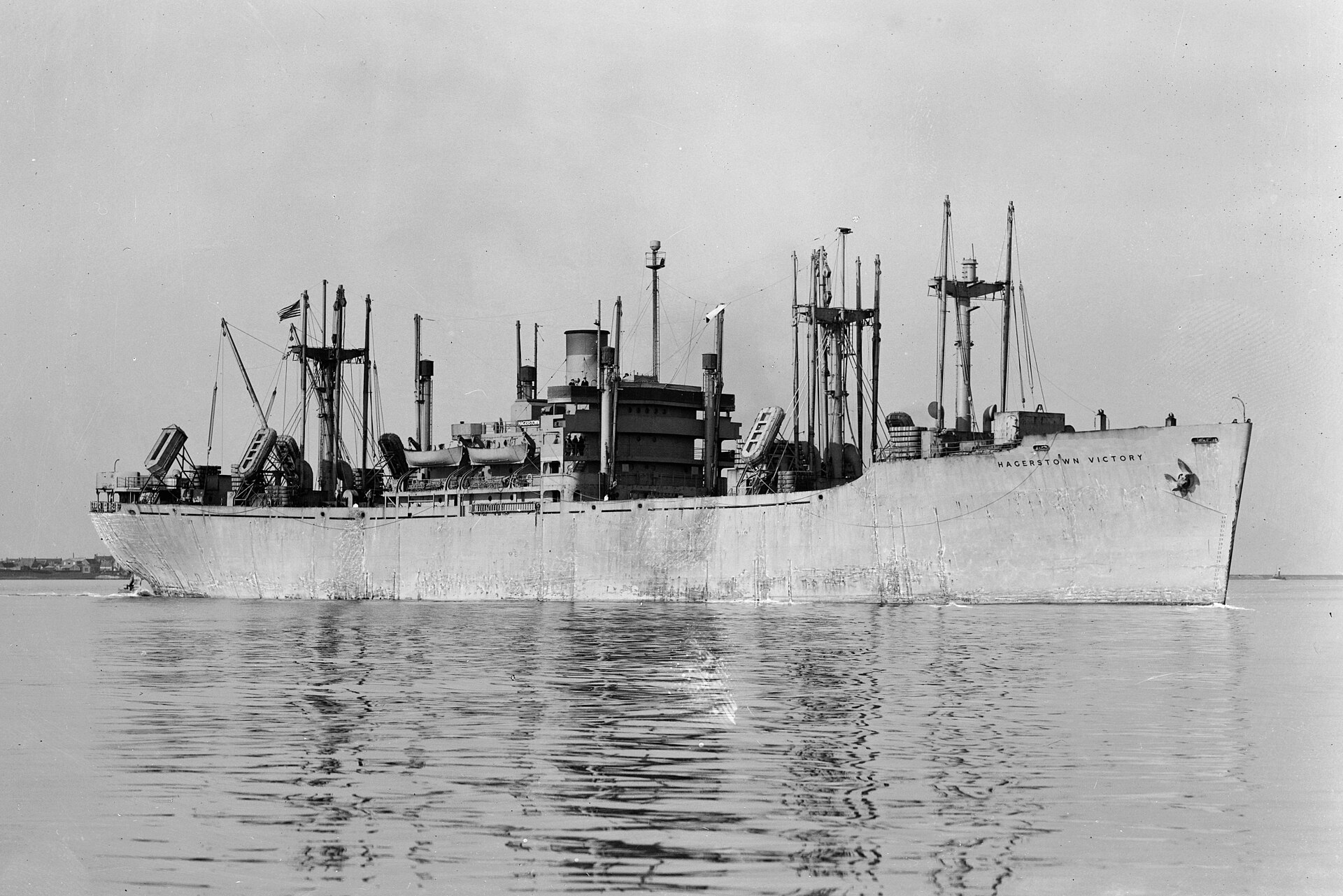
The Hagerstown Victory was the 32nd Victory ship completed at Bethlehem-Fairfield Shipyard.
It was 455 feet long, with a sixty-two foot high beam, and armed with guns and cannons for use
against aircraft. The ship was completed on February 12, 1945, after fifty-six days, with The
Morning Herald announcing its completion.
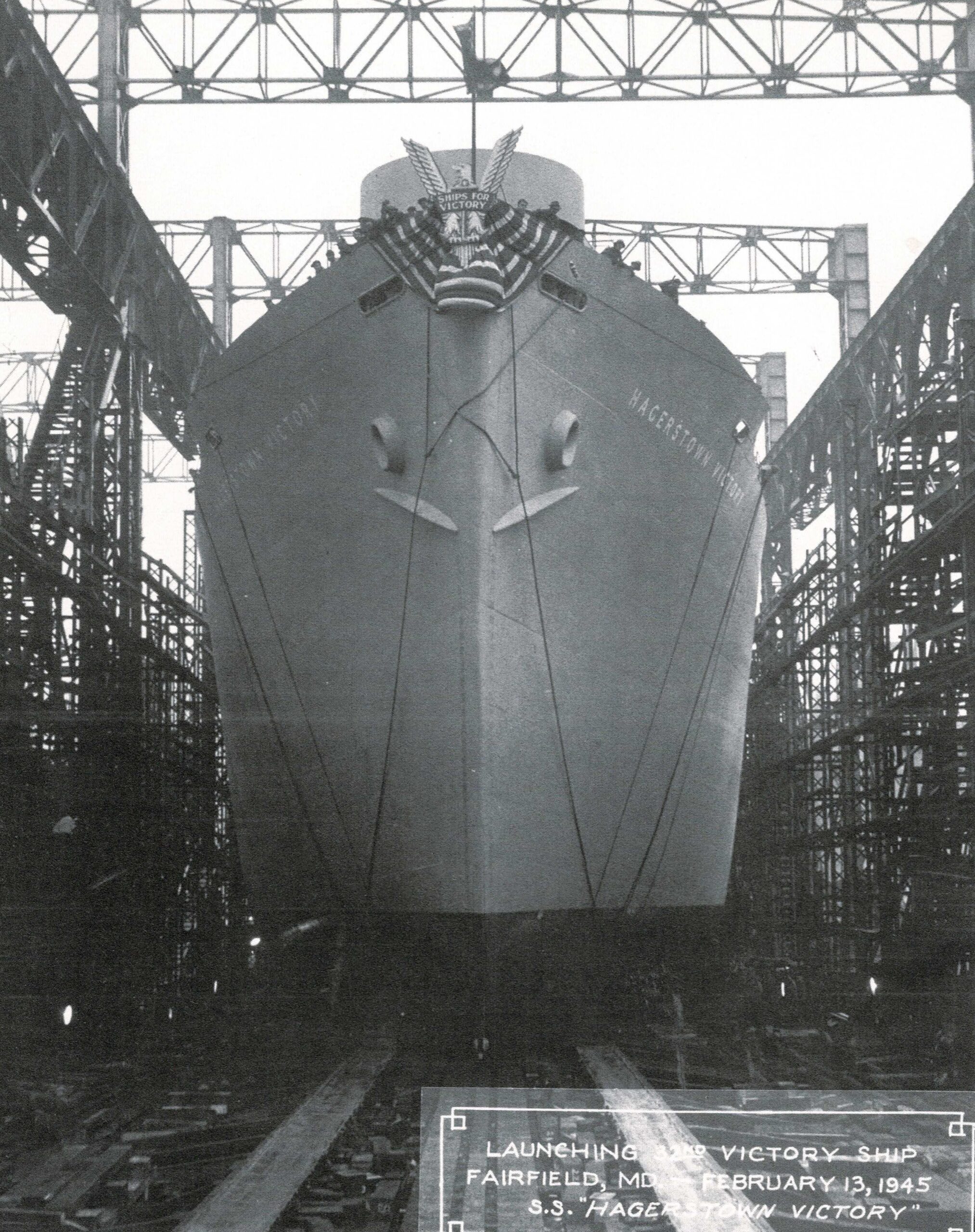
On Tuesday, February 13, Hagerstown dignitaries gathered at the Bethlehem-Fairfield Shipyard
in Baltimore to watch the Hagerstown Victory’s official launch. Despite a drizzly rain, over fifty
Washington Countians attended, including Hagerstown Mayor Richard H. Sweeney and his
sister, Josephine Sweeney; Chamber of Commerce President H. L. Mills; Mary (Vernon) Mish, President of the Washington County Historical Society; and Thomas W. Pangborn and J. V. Jamison, Jr.
With the Hagerstown Victory sitting in its slipway, Josephine Sweeney, the ship’s sponsor,
opened a bottle of champagne against its bow. Hundreds of onlookers cheered as the Hagerstown
Victory slid down the slipways into the harbor. According to The Herald-Mail, “it was the first
time Hagerstown…had been so honored.”
The Hagerstown Victory soon prepared to join the nation’s merchant fleet. By March 24, the
Hagerstown Victory had made a successful trial run in the Chesapeake Bay, undergoing eleven
hours of testing by Maritime Commission inspectors. Tests included a six-hour endurance run;
anchor and rudder tests; and rigorous testing of the ship’s turbine engines operating in reverse
and full speed.
Under the Maritime Commission, the Hagerstown Victory was operated by Calmar Steamship
Company and captained by Sven A. N. Englund (1888-1971). Captain Englund was a native of
Visingsö, Sweden, who had emigrated to Brooklyn, New York, in 1910, and served as a
steamship officer during WWI.
Captain Englund and a crew of eighty-four men sailed the Hagerstown Victory to Mobile,
Alabama, where the cargo ship accepted machinery and supplies for its first voyage across the
Atlantic to Odessa, Russia.
By October 1945, the Hagerstown Victory was outfitted as part of the U.S. Army Transportation
Corps, capable of transporting 1,500 troops with a cargo hold converted to sleeping quarters,
mess halls, and exercise rooms. By December 1945, the Hagerstown Victory had made three
round-trip voyages to Europe, returning with a total of 5,820 veterans from the European theater,
in addition to German and Italian prisoners-of-war.
Through censored letters, Captain Englund kept Mayor Sweeney informed of the Hagerstown
Victory’s movements, which included sailing to Gibraltar, Istanbul, Marseille, and Oran. The
ship experienced one close call on October 16, 1945, when the ship narrowly avoided a Nazi
mine in the English Channel that had “eluded detection” by the crew.
Despite the war’s formal conclusion on September 2, 1945, demobilization continued into 1946.
Bethlehem-Fairfield Shipyard ceased operations in 1945, having produced 385 Liberty ships,
forty-five Landing Ship Tanks (LSTs), and ninety-four Victory ships.
In June 1946, the Hagerstown Victory joined other Victory ships as part of the National Defense
Reserve Fleet in the James River, near Lee Hall, VA. Some Victory ships were sold as commercial freighters, while the U.S. military used others in the Korean and Vietnam Wars. Hagerstown Victory entered service again during the Vietnam War as a cargo ship operated by Oceanic Ore Carriers of New York.
By August 1967, Chatham Shipping Corporation purchased Hagerstown Victory, renaming it the
Chatham. The ship underwent a further purchase and name change in 1969, becoming the
Windjammer Janeen for Windjammer Shipping Inc. In August 1970, the ship’s name changed one final time to the M.V. (Merchant Vessel) Julep, purchased by Trans World Shipping Ltd. of Panama to operate as a cargo vessel.
In mid-November 1970, less than three months after the Julep’s purchase, a tropical storm began
brewing off the northwest coast of the Philippines. Called “Typhoon Patsy,” the storm made
landfall on November 19 in Luzon, the Philippine’s largest and most populated island, before
striking the South China Sea and Vietnam.
In the midst of Typhoon Patsy, with wind speeds reaching 155 mph, the cargo ship Julep was
steaming across the Luzon Strait from Taiwan to the Philippines. On November 20, Julep’s crew
sent out an SOS signal, received by port authorities in Kaohsiung, Taiwan. Three ships
responded to the distress signal, saving twenty-two Julep crew members, but sadly nine crew
members perished.
The Julep officially sank off the coast of Luzon at Latitude 17°30’N by Longitude 119°10’E, the
final resting place of the Hagerstown Victory. Typhoon Patsy claimed approximately 270 lives,
although the ongoing Vietnam War made this number difficult to verify.
From the WWII shipyards of Baltimore Harbor as the S.S. Hagerstown Victory, to the floor of
the West Philippine Sea as the M.V. Julep, the Victory ship named after Hagerstown reminds us
of Washington County’s contributions to its country during World War II.

Related posts

CORPORATE PARTNERS